
If a green owl can get people to practise Portuguese 400 days in a row, imagine the same psychology pointed at Scripture. A Bible reading streak uses one of the strongest motivators known to behavioural science — the desire not to break a visible chain — to carry you through the weeks when motivation dips. And motivation always dips.
"Blessed is the man… whose delight is in the law of the LORD, and on his law he meditates day and night." Psalm 1:1–2
Notice: day and night. Scripture itself commends rhythm and constancy. A streak is just a modern scaffold for an ancient practice.
Why streaks work (and when they backfire)
Streaks work because they:
- Make consistency visible. Day 9 exists somewhere you can see it — suddenly today's reading protects something real.
- Shrink the decision. "Do I keep the chain?" is easier than "Do I feel like reading?"
- Reward showing up, which for habit formation matters more than session length.
They backfire when the number becomes the point — when a broken streak feels like a broken relationship with God. It isn't. God's mercies restart every morning (Lamentations 3:22–23); your counter is allowed to as well. Use the streak as scaffolding for delight, never as a scorecard for acceptance.
What streak tracking looks like in Rhemack
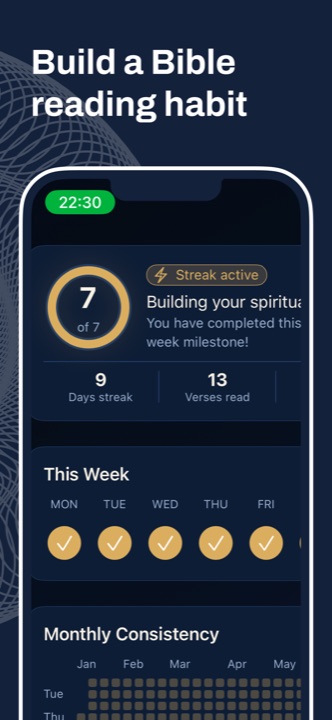
Rhemack helps you see your consistency around one intentional verse a day:
- Daily streak — your current chain of days in the Word.
- Verse history — a record of the Scripture you've read and can revisit.
- Monthly & yearly insights — simple summaries of your engagement with Scripture over time.
Streak rules that keep it healthy
- Define the win as one verse. Small enough to keep on your worst day — that's the whole point.
- Broke the chain? Read the next verse. The habit is the prize; the number is decoration.
- Review monthly, not daily. A longer view tells a truer story than any single day — aim for consistency, not perfection.
- Let the streak retire itself. The day you'd read the verse anyway, the scaffold has done its job. Keep it for fun.