
You open your phone to check one thing. Forty minutes later you're anxious, tired, and can't remember most of what you saw. If that sounds familiar, you're not weak — you're normal. Doomscrolling is the compulsive consumption of feeds (often negative news and social media) driven by apps that are deliberately designed to keep you swiping.
The fix is not "try harder." The fix is to change what happens in the two seconds before the scroll starts.
Why willpower alone fails
Every scroll session follows the same habit loop: a trigger (boredom, stress, a notification), a routine (open the app, swipe) and a reward (a hit of novelty). You lose the battle at the trigger, not in minute thirty. By the time you're scrolling, the decision was already made on autopilot — which is why deleting apps for a week or promising yourself "just five minutes" rarely survives a stressful Tuesday.
Habits are broken by interrupting the loop and replacing the routine, not by resisting it.
What the Bible says about your attention
Scripture treats attention as a spiritual matter — what you behold shapes what you become:
"Do not be conformed to this world, but be transformed by the renewal of your mind." Romans 12:2
"Finally, brothers, whatever is true, whatever is honorable, whatever is just, whatever is pure… think about these things." Philippians 4:8
Doomscrolling is, at its core, a discipleship problem: your mind is being formed daily — the only question is by what. The goal isn't merely less screen time; it's redirected attention.
A 5-step system to stop doomscrolling
- Name your triggers. For two days, notice when you reach for your phone: waking up, waiting in line, after hard conversations. Awareness comes first.
- Add friction at the source. Move feed apps off your home screen — and better, put them behind a shield that interrupts the autopilot tap.
- Replace the first scroll with Scripture. The habit loop needs a routine; give it a better one. One verse takes under a minute — small enough to actually happen.
- Give your brain a finish line. Open-ended feeds never end; a single verse with a reflection does. Completion, not exhaustion, ends the session.
- Track the wins. Streaks and weekly check-ins make the invisible habit visible and keep you going after the novelty wears off.
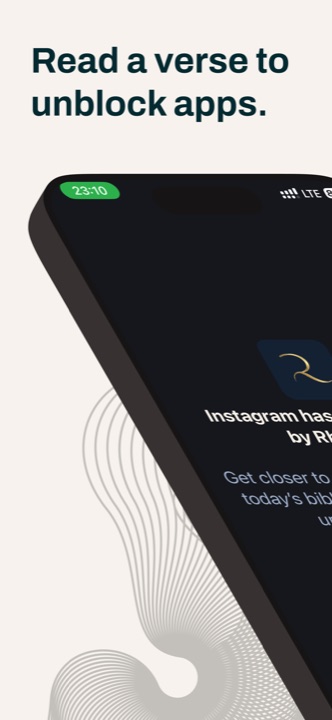
What changes when the first scroll is a verse
Most doomscrolling sessions die at the interruption — you realise you didn't actually want to be there. The sessions that continue start from Philippians instead of a panic headline. Either way, you win: your day's first input becomes God's Word, and over weeks the reflex itself weakens. Users describe it as "direction instead of distraction."